
SUDEVCO Perspectives
In Probiotics, the Best-Documented Strain Rarely Wins
Hundreds of evidenced strains sit unused while marketed strains with no strain-specific proof fill the shelf. What wins is the bundle — a consumer lane, a claim you may legally make, and a documented strain sourced into it.
Wesley Carpentier · June 2026
A documented probiotic strain is the price of entry now, not the prize. There are hundreds of deposited strains carrying their own human trials, and most sit on no shelf at all. Meanwhile the strains that do fill the shelf are often the ones with the least strain-specific proof. The market still pays for the strain and underpays the thing that actually sells it: a consumer lane, and a claim you are allowed to make. So my call cuts against the standard advice to “own the hero strain.” The strain is the sourcing leg. The consumer lane is the franchise. Value accrues to whoever owns the lane and sources a documented strain into it — not to whoever owns the strain alone.
I’m not calling this from the bleachers — I spent the commercial half of my career selling this kind of biology, from global business development at Danisco (now part of IFF) to the commercial side of consumer-health companies like Inbiose and S-Biomedic. What sold and what didn’t was almost never the molecule.
The shelf says evidence and demand have come apart
When you look across the consumer shelf — in our case the SUDEVCO Probiotics Shelf Database, roughly 3,900 products joined to the strain-level evidence behind them — the pattern is consistent and a little uncomfortable. The most-adopted strains frequently carry no strain-specific evidence; the best-evidenced strains sit under-adopted.
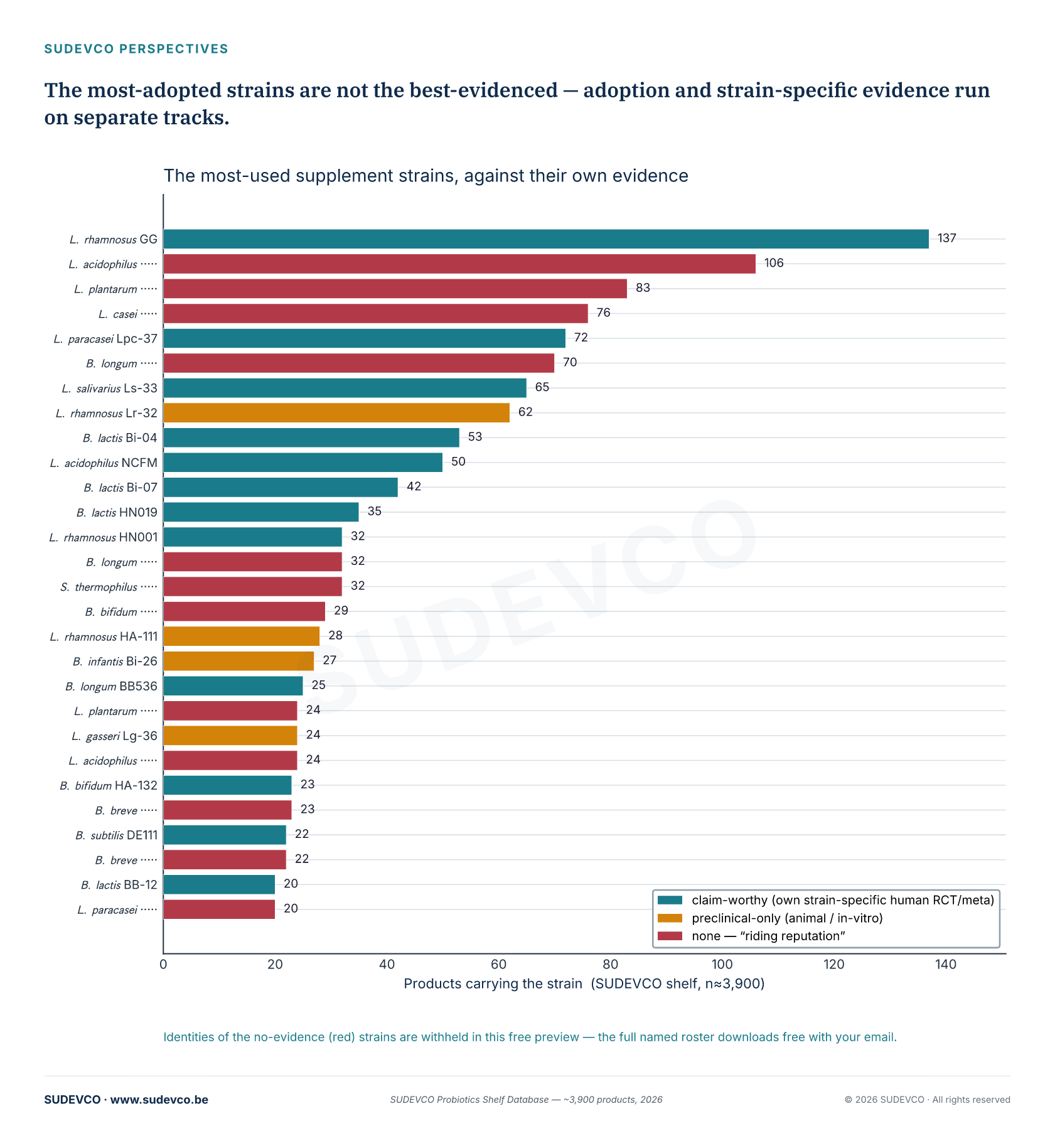
A handful of the highest-adoption strains on the shelf appear in dozens of products each while resting on species reputation or a sister strain rather than a trial of their own. At the same time, roughly four dozen genuinely claim-worthy strains are adopted in only a handful of products. The evidence on those is already paid for — someone ran the trial — and the market simply has not bought it.
The frontier shows the same gap in sharper form. “Akkermansia” is named on the order of a hundred products today; two or three of them link a verified deposit. The hype runs years ahead of the strain.
And the shelf sorts cleanly by durability: the single most durable lane — products built on an owned, documented strain at a premium — is the smallest, around an eighth of the shelf, while the commodity floor is the largest, and roughly half the shelf runs the two most fragile recipes. The durable position is rare precisely because most of the market is competing on something other than a documented strain.
Put plainly: documentation and demand are decoupled. Evidence is necessary. It is not what sells.
The obvious objection is Lactobacillus rhamnosus GG — the most-studied probiotic strain there is, and one of the most-used in the world. Doesn’t that break the rule? It is the case that proves it. LGG did not win on its trials. It won on the whole bundle — the strain-specific evidence, plus an owner who could deploy it, a clearable format, a genuinely shopped symptom (paediatric and antibiotic-associated diarrhoea), and a brand and channel, Culturelle, that carried it into homes and pharmacies. Take away the brand and the distribution and LGG is not number one; the evidence alone never put it there. The best-documented strain in the world is itself the proof that the bundle, not the strain, is the asset.
What actually sells, and the bundle that captures it
Demand sits downstream of the strain — in the shopped symptom, the claim, and the channel. Consumers search their problems, not their solutions: digestive comfort, bloating, women’s health, “after antibiotics.” They search Ozempic, not “probiotic for weight loss” — which is effectively zero in consumer search everywhere I have measured it. The opening that the GLP-1 wave actually creates is the symptom it leaves behind — digestive regularity — not a metabolic hero strain.
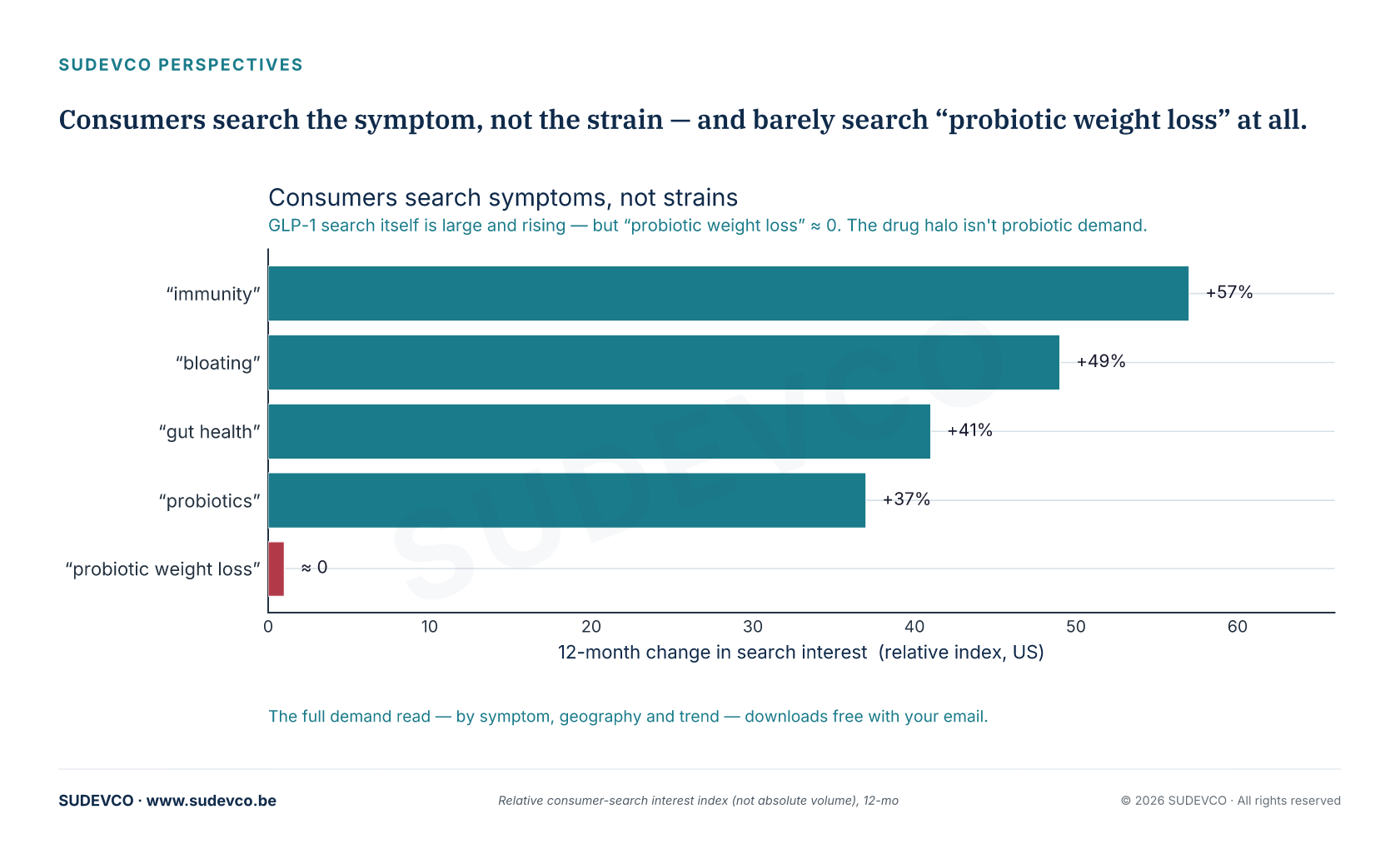
So the scarce, ownable asset is not the best strain. It is the complete bundle.
Most documented strains fail at least one of these. Identifying the few that pass — and being precise about why the rest do not — is the work, and it is not work a strain list can do. The senior asset in this category is the consumer position; a sufficiently documented strain is sourced into it as an input.
The honest caveat
I will not oversell the call, because two things complicate it and a careful buyer asks about them first.
Low Western adoption is not the same as availability. A strain that looks unused on the European or US shelf is often fully deployed out of sight — as a business-to-business ingredient, or across Asian markets — and may be captive to a single brand or simply not for licence. Align’s strain, B. longum 35624, is the clean example: strong digestive evidence, committed to one brand, not offered for licence. It clears the evidence gate and fails the willing-owner gate.
The trending positioning is frequently not a claim you may make. In the European Union, metabolic and weight claims for probiotics are effectively closed; there the opportunity is the ingredient and the format, not the words on the pack. And converting a live metabolic strain into a shelf-stable postbiotic — the form a mass-market brand wants — is a fresh clinical-development project, not a relabelling, because for several of those strains the effect appears tied to the living organism.
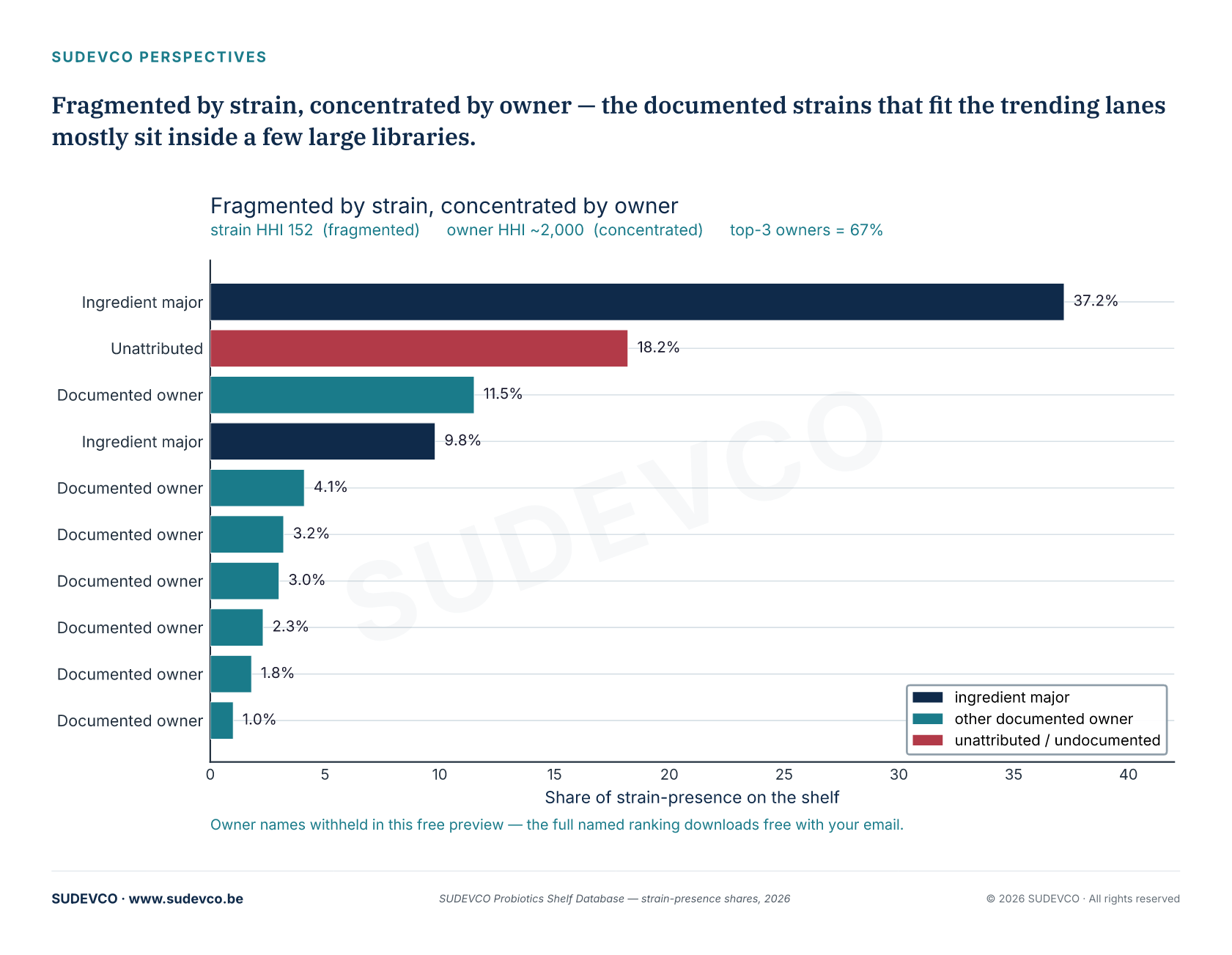
One more, because it changes the shape of the opportunity: the documented strains that fit the trending lanes are, for the most part, already held by the established suppliers — a cholesterol strain, a body-fat strain, a digestive franchise, a women’s-health pair, all sit inside the larger libraries today. This is less an under-priced-strain hunt than an assembly problem.
What to do with this
The same call reads differently depending on where you stand.
If you build or own a consumer brand: own the lane and a permitted claim first, and source a documented strain into it — rather than overpay for a marketed “hero.” The consumer relationship is the franchise; the strain is an input. The under-adopted, well-evidenced strains are the cheaper, smarter supply, if you can confirm they are actually available to you.
If you supply strains: license your documented strains into the lanes, channels and geographies your own sales do not reach, and sell by indication-fit, not by species. The commodity name-drop — a genus on a label with no deposit behind it — is a race to the floor; the durable money is in the documented bundle, sold to a buyer who needs exactly that fit.
The through-line is a single shift. Commercial success in this category has rested less on scientific evidence than on brand and distribution. That is beginning to change, as demand concentrates into the areas where consumers expect a real effect and as the basis for claims is examined more closely. As it changes, the advantage moves toward whoever owns a consumer position and can pair it with a documented strain — and away from whoever owns the strain alone.
There’s a fuller version of this call — the strain-by-strain evidence behind it: who owns what, whose evidence actually travels to a new format and market, and where the real openings sit, written for brands on one side and strain suppliers on the other. If you’re weighing a specific pipeline, customer book, or licensing target, the move that pays is to run the test against your own situation rather than the market’s. That’s what an advisory conversation is for.

About the author
Wesley Carpentier, PhD, writes SUDEVCO Perspectives from the operator side of the bio-based economy. He led global new-market development at DuPont Industrial Biosciences (the Danisco / Genencor fermentation business across the US, NL and CN), was CCO/COO at S-Biomedic through its acquisition by Beiersdorf, and served as CCO and later CEO of Inbiose.
SUDEVCO Atlas
Ask Atlas and ChatGPT the same question.
One answer is grounded in fact. The other is confidently made up.
Atlas pairs a cross-linked evidence base — every figure traced to a real, dated source — with twenty years on the operating side of these industries. Fact, calibrated by experience.
Biotics · supply side
Strain passports
~400 strains, each resolved to its deposit, human trials, IP family, regulatory standing and owner — so a supplier, strain or licensing target resolves to one identity, not a guess.
Biotics · demand side
The consumer shelf
~8,500 products across 70 retail platforms in 30+ markets — ~3,900 cross-linked to the strain and the evidence behind the claim, read against 12,600 consumer reviews.
Beyond biotics
The wider map
HMOs (40 clinical trials, 17 production sites, the patent landscape), precision-fermentation dairy (26 players), the raw-material transition (54 companies), and a bio-based registry of 400+ companies across 580 sites.
We don’t sell access to Atlas — it’s the BI engine behind a bespoke engagement.
Run this against your own situation
Weighing a specific decision in this space? These calls are filters you can apply before you commit capital — bespoke, confidential advisory for investors and operators.
See advisory →More research
SUDEVCO's sector research across the bio-based economy and health & nutrition — written from inside the industry, with named, dated, falsifiable calls.
Browse research →