
SUDEVCO Perspectives
Animal-Free Dairy Is Shaking Out. The Wedge Already Knows Who Survives.
Precision-fermentation dairy raised billions; now its best-funded names are in open distress. The split between the survivors and the casualties isn't luck or hype — it's the wedge, and you can read it on today's cap tables.
Wesley Carpentier · June 2026
Animal-free dairy is having its reckoning. The companies that raised the most are stalling, a flagship plant has been cancelled, and at least one large incumbent has quietly walked away from the field. Two readings are going around. One says the science failed — it didn’t. The other, popular among founders right now, says the thesis was sound and only the execution failed — which is closer, but lets the wrong companies off the hook. What’s actually failing is a structure, and no amount of execution saves you on the wrong side of it. It’s the exact shape the bio-based-economy graveyard failed in twenty years ago.
I’m not calling this from the outside. I spent the commercial half of my career selling this kind of biology — global business development at Danisco, then chief-commercial and operating roles in consumer-health biotech (Inbiose, S-Biomedic) — and I sat through the bio-based-economy version of this exact movie, when a generation of “drop-in, greener, cheaper-someday” molecules raised billions and went bankrupt anyway. Same script, new cast.
The reckoning is already on the record
This isn’t a forecast. Perfect Day — the most-funded name in the category, close to $800 million raised — has lost its founders, cut staff, leaned on an insider bridge round, and watched its marquee consumer launches disappear. Remilk shelved its Danish mega-plant and hasn’t raised an up-round since 2021. And FrieslandCampina, after dabbling, ended its precision-fermentation programme outright in 2025 as “not economically viable.” The best-capitalised drop-ins are stalling, and the incumbents who tried the drop-in are backing out.
Line the field up by one question
Ask of each company the only question that has ever mattered here — does the protein have a wedge, or is it a drop-in? — and the distress sorts itself.
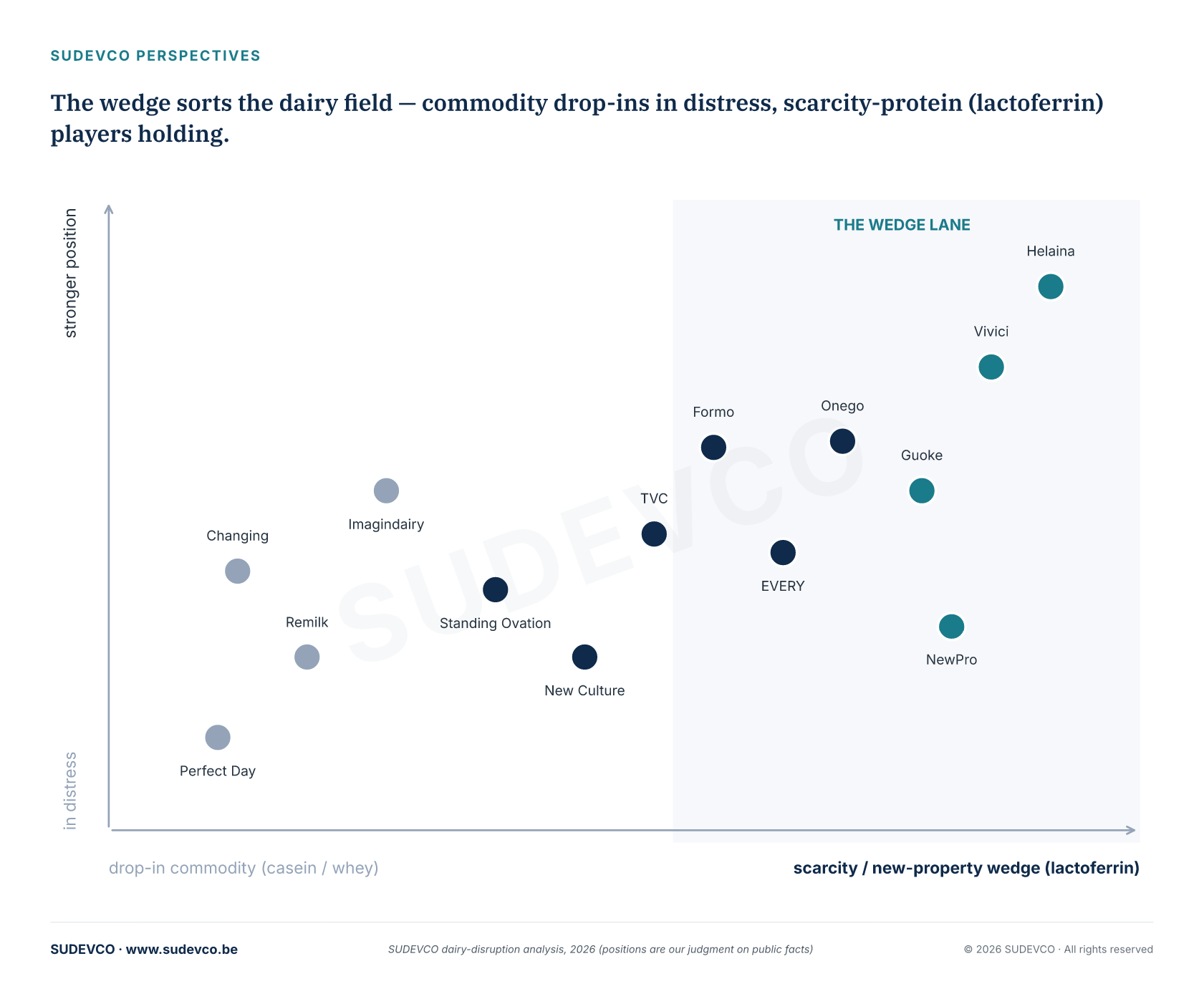
The commodity whey and casein players — Perfect Day, Remilk, Changing — are the drop-ins: a protein engineered to be chemically identical to dairy, sold on sustainability virtue, against one of the cheapest, most entrenched commodities on earth. And the molecule was never the hard part. The food-ingredient incumbents didn’t win on cost — they spent decades learning to make these proteins at industrial scale and what their ingredients actually do in a real food, and they apply them better than anyone alive. Equivalence was the easy story to raise on; investors understand “the same thing, greener.” But out-matching a giant on its own molecule, its own cost base, and its own applications mastery is the hard path — and for many of these players it won’t be the one that lasts. The strength sits in the other corner: the scarcity proteins, lactoferrin above all — Helaina and Vivici in the West, Guoke and NewPro in China. Lactoferrin is genuinely scarce and costly to pull from milk, so the fermentation route isn’t a cheaper copy of a cheap thing — it’s the only practical way to supply it. Between the two poles sit the ovalbumin (Onego, EVERY) and functional-casein (Formo, Standing Ovation) plays: real wedges, but contested ones.
And identical is carrying more weight than the pitch admits. The same gene dropped into a microbial host doesn’t reproduce how a milk protein is folded and modified — the phosphorylation that makes casein behave like casein, in a cheese, the glycosylation the gut and microbiome actually read. For a scarce, functional protein, “close and available” still sells. For a commodity whose whole promise is identical, just greener, a quality gap stacked on a cost gap is the opposite of a moat — and the cleanest answer isn’t a bigger round, it’s to stop selling parity and start selling a function only you can supply.
The wedge isn’t only economic. The commodity proteins are crowded legally too — incumbent whey patents run into the next decade, the casein host-cell space is contested, and an ovalbumin patent fight hangs over two of the egg-protein names. Lactoferrin, the strongest wedge, also has the cleanest path. Double moat for the wedge; double crowding for the drop-in.
Watch where the incumbents actually put money
The clearest tell isn’t in the startups — it’s in the majors, because they are voting with their balance sheets, and a clean split shows up. The committed bets — Bel and Danone into Standing Ovation’s casein, Fonterra and dsm-firmenich building Vivici’s whey-and-lactoferrin — are all on a functional or scarcity protein, and they are backed the serious way: equity, a joint venture, shared feedstock. The commodity drop-ins get the opposite — a small option, a polite pass, or, as with FrieslandCampina, a full exit from precision fermentation. Two strategies, one pattern: conviction follows the wedge; hedging and exits follow the drop-in. And no dairy major is building animal-identical milk in-house.
Two things the cap table won’t tell you at a glance. “Picked by a major” is not survival — Perfect Day had ties to Nestlé and Bel and is still in distress; the only incumbent grade that has held is committed equity, a JV, or real feedstock. And capital is not strength — Imagindairy is the healthiest of the drop-ins on a small fraction of Perfect Day’s raise, because capital discipline plus a committed offtake buys runway. But runway is not a destination. A drop-in with a tidy balance sheet is still a drop-in.
And a wedge tells you whether, not when. A scarcity play can still stall — Helaina carries real regulatory exposure, the egg-protein names are years from their own plants — so read the catalysts, not just the cap table: the pending patent fight, the next financing, the first commercial-scale plant.
If you’re building in this, read your own position
For the founders watching the headlines with a knot in the stomach — I’ve written this as a turnaround brief, not an obituary. There’s real invention in this field; the question was never whether the science is clever, only what you point it at.
This isn’t really a dairy story — it’s the pattern I opened with, and other bio-based industries have already lived it. The globally diverse starch industry is the constructive version: the value never stayed in native, commodity starch; it moved up, into modified and specialty starches engineered for a function and sold by people who knew how to apply them better than anyone. The way out of the commodity trap was never a cheaper copy — it’s a property only you have.
About the author
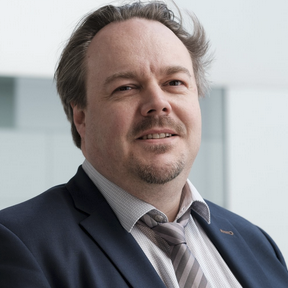
Wesley Carpentier, PhD, writes SUDEVCO Perspectives from the operator side of the bio-based economy. He led global new-market development at DuPont Industrial Biosciences (the Danisco / Genencor fermentation business across the US, NL and CN), was CCO/COO at S-Biomedic through its acquisition by Beiersdorf, and served as CCO and later CEO of Inbiose.
SUDEVCO Atlas
Ask Atlas and ChatGPT the same question.
One answer is grounded in fact. The other is confidently made up.
Atlas pairs a cross-linked evidence base — every figure traced to a real, dated source — with twenty years on the operating side of these industries. Fact, calibrated by experience.
Biotics · supply side
Strain passports
~400 strains, each resolved to its deposit, human trials, IP family, regulatory standing and owner — so a supplier, strain or licensing target resolves to one identity, not a guess.
Biotics · demand side
The consumer shelf
~8,500 products across 70 retail platforms in 30+ markets — ~3,900 cross-linked to the strain and the evidence behind the claim, read against 12,600 consumer reviews.
Beyond biotics
The wider map
HMOs (40 clinical trials, 17 production sites, the patent landscape), precision-fermentation dairy (26 players), the raw-material transition (54 companies), and a bio-based registry of 400+ companies across 580 sites.
We don’t sell access to Atlas — it’s the BI engine behind a bespoke engagement.
Run this against your own situation
Weighing a specific decision in this space? These calls are filters you can apply before you commit capital — bespoke, confidential advisory for investors and operators.
See advisory →More research
SUDEVCO's sector research across the bio-based economy and health & nutrition — written from inside the industry, with named, dated, falsifiable calls.
Browse research →