
SUDEVCO Perspectives
The Bio-Based Economy Didn't Fail. The Drop-In Bet Did.
In 2004 the DOE named twelve building blocks to bio-base the chemical industry. Two decades on, not one had cleanly displaced a fossil incumbent. Here's the test that sorts the survivors — and what it means for the alt-protein and fermentation scale-ups struggling now.
Wesley Carpentier · June 2026
For twenty years the promise was simple: we would make the chemical industry bio-based by marching molecule after molecule down the cost curve until the green version was as cheap as the fossil one, and then customers would switch. It didn’t work — and the wreckage is specific enough to learn from, which is more than most failed promises leave behind.
In 2004 the US Department of Energy named twelve sugar-derived building blocks as the platform of the coming carbohydrate economy. Walk that list forward to today and ask one hard question of each — did the bio route actually displace a fossil incumbent at commercial scale? — and the answer is sobering: not one of the twelve did. The era’s two genuine wins weren’t even on the list — bio-1,3-propanediol and PLA were already being commercialised when the screen was written (NatureWorks had its PLA plant running in Blair, Nebraska by 2002 on cheap Midwest corn glucose; bio-PDO followed in 2006), and lactic acid only enters in the DOE’s 2010 revision. The screen’s R&D candidates produced no winner; the winners came from commercial pull — and both shared the one thing the twelve lacked — and it is the single most useful thing I know for anyone putting capital into fermentation right now:
I watched this from inside one of the winners
I’m not reading this from the bleachers. I was on the DuPont team that oversaw the whole industrial-biosciences portfolio — every programme, the joint ventures included. Bio-1,3-propanediol — one of the few genuine fossil-displacement wins the whole building-block era produced — was one of ours; I watched the rest of the field stall and fail from the same seat. The difference between the ones that stuck and the ones that went bankrupt isn’t luck, and it’s almost never the chemistry. It’s whether there was a wedge.
The cohort verdict
Here is the twenty-year scorecard for the whole building-block wave — the 2004 twelve, its 2010 revision, and the commercial plays that grew up alongside them:
| Outcome | Count | Representative cases |
|---|---|---|
| Won — genuine displacement | 2 | Bio-PDO (DuPont/Tate & Lyle → CovationBio; corn-glucose fermentation); lactic acid → PLA (NatureWorks, Blair NE; Total Corbion PLA) |
| “Won” — default-bio (nothing fossil to displace) | 4 | MSG/glutamic, itaconic, sorbitol, xylitol — they were never made from oil; they don’t count |
| Emerging | 1 | FDCA/PEF (Avantium, first commercial sale targeted H2-2026 — already slipped once) |
| Stalled | 2 | Aspartic acid, 3-hydroxybutyrolactone — never built at scale |
| Failed | ~4 | 1,4-succinic (BioAmber, Reverdia, Myriant); 3-HP/acrylic (BASF exited 2015); glucaric; levulinic |
| Pivoted | 1 | Amyris — platform overreach (farnesene → fuels → consumer brands) ended in Chapter 11; only the squalane specialty survived |
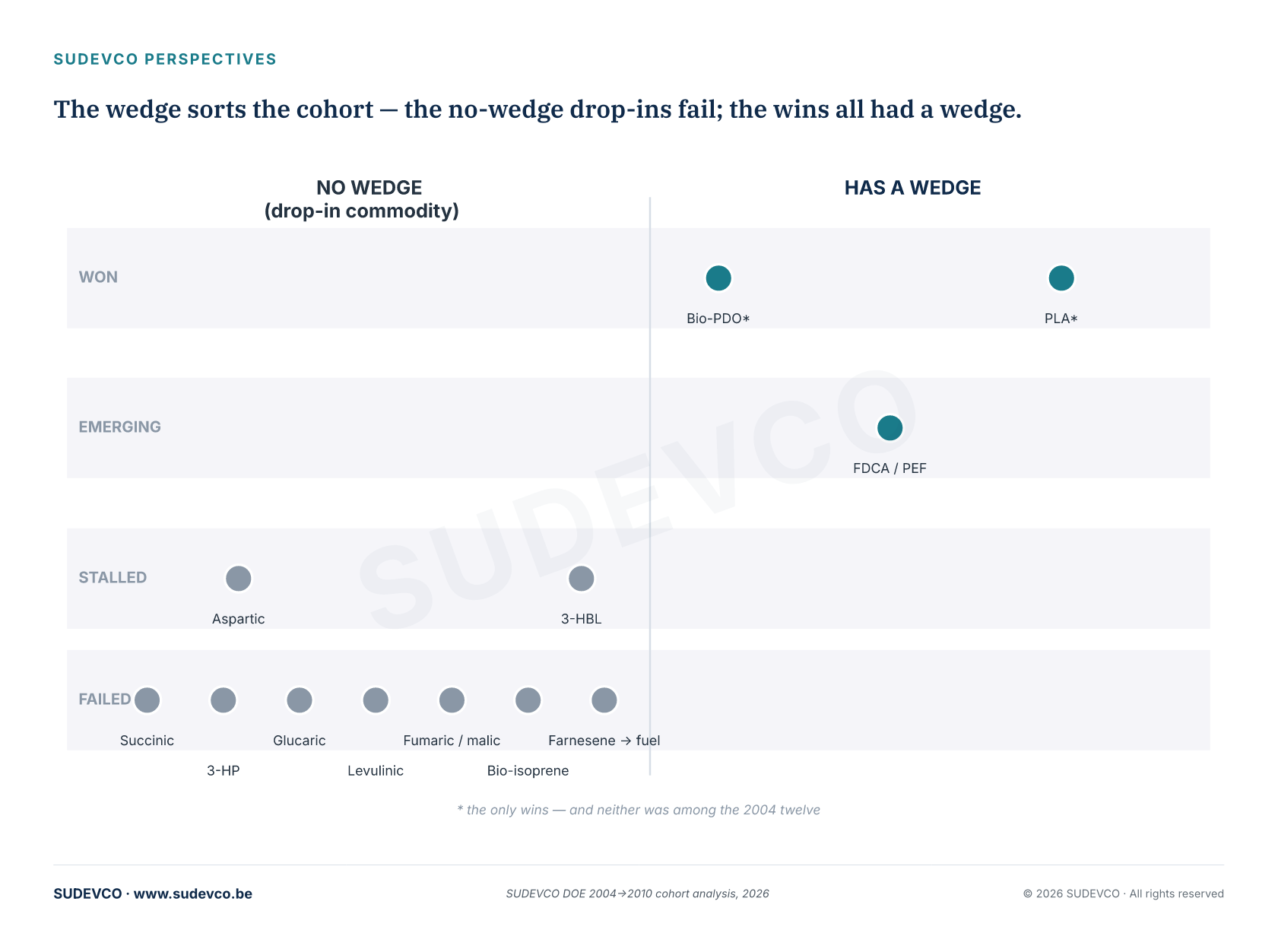
Two genuine wins in twenty years — and here’s what should stop any investor cold: neither was among the original twelve. Both PLA and bio-PDO were already being commercialised before the 2004 screen; lactic acid only enters in the 2010 revision. The four “default-bio” molecules (MSG, itaconic, sorbitol, xylitol) inflate every naïve tally — real industries, but with no fossil incumbent to beat, so they prove nothing about substitution. Of the twelve flagship blocks themselves, the commodity drop-in bets — succinic, 3-HP, glucaric, levulinic — failed; the rest stalled or stayed default-bio.
Every failure had the same shape
This is the part that matters, because it’s a pattern, not a list of unlucky companies. Every failure was a drop-in commodity sold on cost-parity-plus-virtue against a cheap, property-identical petro incumbent, with no non-cost forcing function. Bio-succinic against petro-succinic. Bio-acrylic against propylene-route acrylic. Bio-isoprene against naphtha-cracker isoprene. The technical milestones were often hit — the molecule got made, the polymer got demonstrated — and the companies died anyway, because matching a cheap incumbent on cost-someday is not a reason for a buyer to switch today.
And every win was carried by a wedge. PLA didn’t beat PET on cost; it isn’t even a drop-in for PET — it’s compostable, it runs in fibre and film, and it rides single-use-plastic regulation. Bio-PDO worked because cheap feedstock met a captive, new-property end-market (DuPont’s Sorona polymer) that the petro route couldn’t serve on the same cost curve. The surviving squalane out of the Amyris wreck won on scarcity and purity — replacing shark-liver-derived squalane — not on fuel economics. Not one win is “we matched petro on cost and customers chose green.”
The most telling evidence isn’t mine: the DOE itself walked this arc. Its 2004 screen weighted theoretical pathways and cost potential. By the late 2010s the programme had renamed its target “performance-advantaged bioproducts” — which is just the wedge, stated in government language. I’m not arguing against the DOE. The DOE already moved. Most of the market hasn’t caught up.
Precision-fermentation dairy: the same play is running again — louder
Now look at the fermentation scale-ups struggling today, and you’ll see the drop-in delusion rebuilt with new branding. Take the loudest example, precision-fermentation dairy. Some of it has a real wedge — proteins that are scarce, or do something the cow can’t. But the bulk of the capital has gone into the commodity proteins: casein and whey engineered to be chemically identical to the dairy version, sold on sustainability virtue, against one of the cheapest, most entrenched incumbents on earth. That is the BioAmber shape exactly — identical-but-greener, betting on a cost curve that has to cross before the capital runs out.
The survivors are the wedge-havers — the ones making something the incumbent can’t (a genuine new property), or locked to a constrained feedstock, or pulled through a hard regulatory or scarcity gate. The escape route already has a template — the squalane move: when the commodity dream dies, the specialty wedge survives. Amyris, the platform that overreached from fuels into consumer brands, went to Chapter 11; the squalane wedge sold to Givaudan and lives. The lesson for a struggling platform isn’t “try harder on cost.” It’s “find your wedge — or become its supplier — before the runway ends.”
The honest caveat: a wedge tells you whether, not when
I won’t oversell the test, because the graveyard contains a warning about the test itself. A wedge is necessary, not sufficient. BioAmber had a working 30,000-tonne plant in Sarnia, real product, a Mitsui joint venture, real offtake — and still filed Chapter 11 in 2018, barely two and a half years after commissioning, because the late-2014 oil-price collapse evaporated the green premium and the runway to a scaled cost curve ran past what the capital structure could fund. Even a molecule with a plausible wedge can die early if the capital isn’t patient enough to let the wedge harden. So the test is two-sided: no wedge is a guaranteed loss; a wedge plus impatient capital is a coin-flip. Both halves decide it.
What to do with this
For the people who actually carry the risk in this industry, the wedge test isn’t commentary — it’s a filter you can use before you commit money.
If you toll-manufacture or build capacity for others: the wedge test is your customer-selection filter. A client whose only story is “drop-in, greener, cheaper once we scale” is a stranded-asset risk — you’ll build the line and they’ll run out of runway before the cost curve closes. The capacity that stays loaded is the capacity built for a wedge-haver.
If you’re a process biotech scaling a molecule: ask honestly whether yours is a wedge or a drop-in, before the next raise. If it’s a drop-in commodity, no amount of scale-up heroics fixes a missing wedge — the unit economics never beat the incumbent. The companies that survived this cohort are the ones that found the wedge, or pivoted to it, while they still had the capital to move.
There’s a fuller version of this call — the complete wedge framework, the map of where substitution wins and loses, and the sourced cases behind every line above, across the DOE cohort, the historical record, and today’s wave. If you’re weighing a specific molecule, pipeline, or acquisition, the move that pays is to run the test against your own situation rather than the market’s. That’s what an advisory conversation is for.
About the author
Wesley Carpentier, PhD, writes SUDEVCO Perspectives from the operator side of the bio-based economy. He led global new-market development at DuPont Industrial Biosciences (the Danisco / Genencor fermentation business across the US, NL and CN), was CCO/COO at S-Biomedic through its acquisition by Beiersdorf, and served as CCO and later CEO of Inbiose.
SUDEVCO Atlas
Ask Atlas and ChatGPT the same question.
One answer is grounded in fact. The other is confidently made up.
Atlas pairs a cross-linked evidence base — every figure traced to a real, dated source — with twenty years on the operating side of these industries. Fact, calibrated by experience.
Biotics · supply side
Strain passports
~400 strains, each resolved to its deposit, human trials, IP family, regulatory standing and owner — so a supplier, strain or licensing target resolves to one identity, not a guess.
Biotics · demand side
The consumer shelf
~8,500 products across 70 retail platforms in 30+ markets — ~3,900 cross-linked to the strain and the evidence behind the claim, read against 12,600 consumer reviews.
Beyond biotics
The wider map
HMOs (40 clinical trials, 17 production sites, the patent landscape), precision-fermentation dairy (26 players), the raw-material transition (54 companies), and a bio-based registry of 400+ companies across 580 sites.
We don’t sell access to Atlas — it’s the BI engine behind a bespoke engagement.
Run this against your own situation
Weighing a specific decision in this space? These calls are filters you can apply before you commit capital — bespoke, confidential advisory for investors and operators.
See advisory →More research
SUDEVCO's sector research across the bio-based economy and health & nutrition — written from inside the industry, with named, dated, falsifiable calls.
Browse research →