
SUDEVCO Perspectives
Infant Nutrition Is Gut Science's Frontier Lab — and the 'Just Give a Probiotic' Era Is Closing
The most advanced microbiome science on earth is run for the benefit of babies — the first 1,000 days are the frontier lab, and a leading indicator for adult health. Four days at the big paediatric gut-and-nutrition congress (ESPGHAN 2026), read as: where pre/pro/post-biotics, HMOs and bioactive metabolites are heading — and where the value migrates next.
Wesley Carpentier · June 2026
The most advanced gut science on earth is done for the benefit of babies — which is exactly why everyone in human health should watch it. The first 1,000 days are the frontier lab: where the microbiome is assembled, where the boldest nutrition science gets deployed, and where the mechanistic patterns that later shape adult metabolic and immune health surface first. Read across four days at the field’s main congress, the through-line wasn’t a breakthrough — it was a category quietly losing its meaning. “Probiotic” is no longer a useful unit: the science, the regulators and the product designers have all moved to a finer grain — which strain, which structure, in which gut — and to the metabolites those microbes make. That is where the next decade of gut-health value accrues — in infant nutrition first, and adult health after.
I spent the four days at ESPGHAN 2026 — the European paediatric gastroenterology, hepatology and nutrition congress, the field’s main meeting — reading it the way I read a portfolio: less for the single result, more for where the weight is shifting. Here is where it shifted.
Probiotics stopped being a class
The cleanest signal came from the podium, not a trial: probiotics are not a class effect, and recommendations stay strain-specific. That sounds like housekeeping; it is the whole game. The unit of value is the strain — with its dose and its evidence — not the word on the tub. The honest counterpoint was on stage too: the two large 2018 trials that found no benefit for some widely used strains in acute gastroenteritis. The field metabolised that — it didn’t retreat to “probiotics work,” it moved to “which one, for what, at what dose.”
The more interesting thing was watching a system move ahead of the meta-analyses. A Swedish register-based programme made a multistrain probiotic routine care for very preterm infants and reported lower necrotising enterocolitis, sepsis and mortality — now being tested at scale across Scandinavia. The national-cohort numbers presented were striking, but they aren’t published yet, so I’ll wait on the magnitude. The direction is real, and the pattern is worth naming: real-world implementation is starting to outrun the trial consensus.
HMOs crossed from “interesting” to “infrastructure”
Human-milk oligosaccharides have stopped being a frontier and become plumbing. Eight HMO structures are already on the EU novel-food list; the EFSA opinion on 3-FL this year was an extension of use — a higher permitted level, not a first clearance — and an opinion still precedes the Commission act that actually authorises. Every market (EU Novel Food, US GRAS, China’s NHC) remains its own multi-year filing. The live question is no longer “is it safe?” but “which structure, how much, which market.”
And the science has moved past the single sugar. An HMO only feeds a gut that already carries the bifidobacteria to use it — so the sharper designs pair the HMO with the strain. One infant trial this year did exactly that: an HMO blend plus B. infantis yielded more B. infantis, a more acidic gut, higher secretory IgA, and fewer respiratory infections. That is the template — structure plus the organism that metabolises it — and it is where formulation is heading.
Prebiotics got specific; bioactives took the room
Prebiotics shed the word “fiber”: GOS versus PDX, fast versus slow fermentation, proximal versus distal colon — structure is the story, and it is turning up even in intestinal failure. But the metabolites are where the mechanism converged. Bile acids ran the room — secondary bile acids and short-chain fatty acids as signalling molecules, the through-line being diet → microbiome → metabolite → barrier, immune, even brain (bovine MFGM and myelination got real airtime). With a quiet warning shot: the emulsifier CMC, common in ultra-processed food, measurably cut stool short-chain fatty acids in a controlled human trial. The bugs are upstream; the metabolites are what act.
The tell — and the supply side
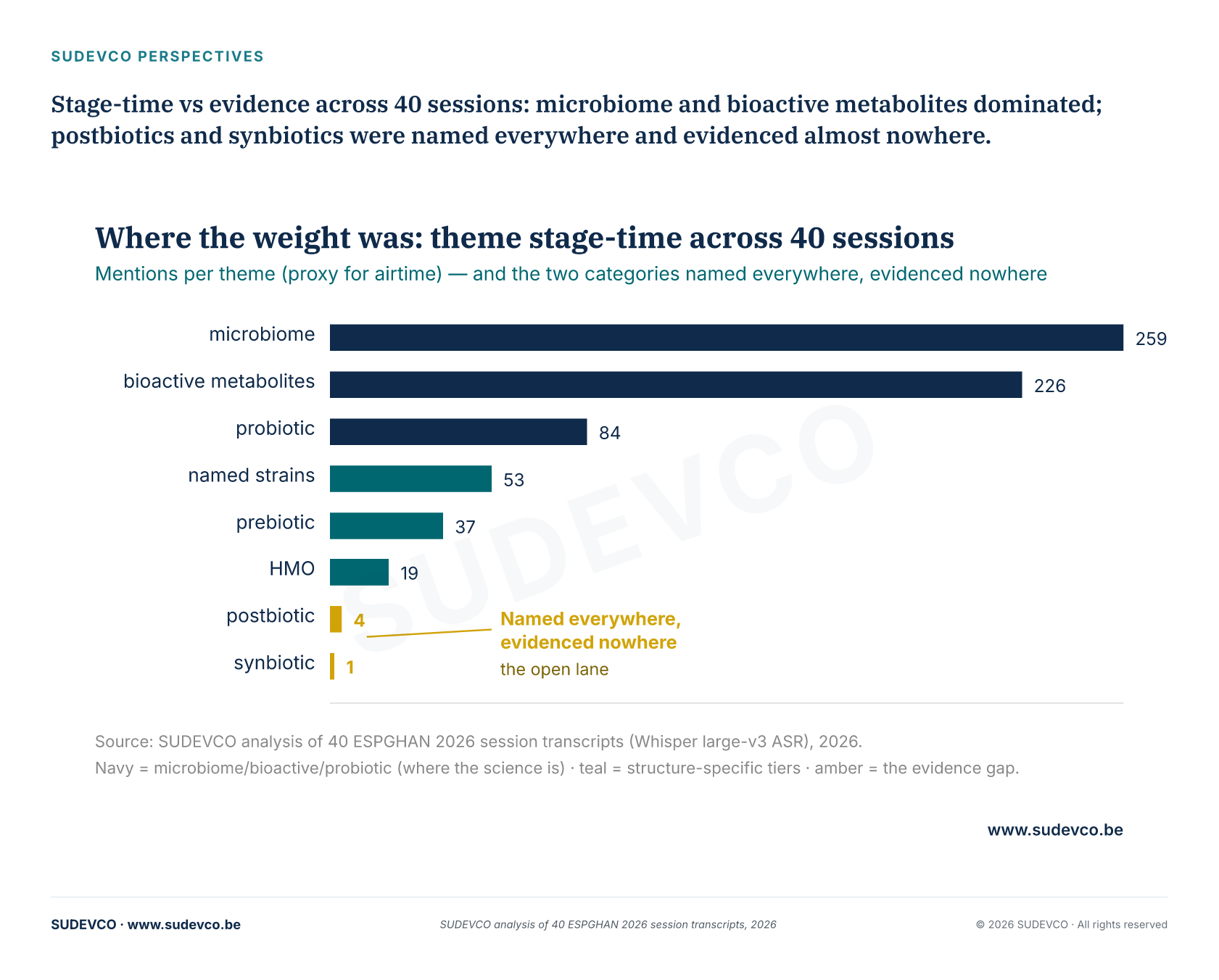
Here is where the white space is: postbiotics and synbiotics were on every taxonomy slide and behind almost no primary data. Named everywhere, evidenced nowhere. That is not a dead end — it is the open field. Whoever generates clean, strain- and metabolite-specific evidence there will own the category.
The supply side already reflects the shift, and it isn’t only an HMO story. The same few houses recur: bio-ingredient majors Novonesis and DSM-Firmenich now own the strains and the sugars — both bought their way in (Jennewein, Glycom) — while the formula majors (Nestlé, Danone, Abbott, Reckitt) package strain-plus-HMO into product. FrieslandCampina took the cheaper, non-fermented GOS route instead. The therapeutic edge belongs to pharma: the bile-acid / IBAT-inhibitor franchises ran their own symposia. And postbiotics? No incumbent owns it yet. The molecule is commoditising; value is migrating to portfolio breadth, regulatory reach, delivery format — and, at the edge, to drugs.
What I’d do with this
If you sell a “biotic,” the defensible position is no longer the category — it’s the matched pair (the strain and the structure it needs), the metabolite you can measure, the claim you can substantiate in the market you actually sell into, and the format that delivers it. If you’re allocating capital, the postbiotic/synbiotic evidence gap is the clearest unclaimed lane in the field. Either way, the work is specificity.
And watch this field even if you never touch infant formula. The first 1,000 days are where these patterns surface first — what proves out in the infant gut is the preview of where adult nutrition and metabolic health go next.
The fully-referenced edition — with DOIs, trial-registry IDs and the full source list — downloads free with your email.

About the author
Wesley Carpentier, PhD, writes SUDEVCO Perspectives from the operator side of the bio-based economy. He led global new-market development at DuPont Industrial Biosciences (the Danisco / Genencor fermentation business across the US, NL and CN), was CCO/COO at S-Biomedic through its acquisition by Beiersdorf, and served as CCO and later CEO of Inbiose.
SUDEVCO Atlas
Ask Atlas and ChatGPT the same question.
One answer is grounded in fact. The other is confidently made up.
Atlas pairs a cross-linked evidence base — every figure traced to a real, dated source — with twenty years on the operating side of these industries. Fact, calibrated by experience.
Biotics · supply side
Strain passports
~400 strains, each resolved to its deposit, human trials, IP family, regulatory standing and owner — so a supplier, strain or licensing target resolves to one identity, not a guess.
Biotics · demand side
The consumer shelf
~8,500 products across 70 retail platforms in 30+ markets — ~3,900 cross-linked to the strain and the evidence behind the claim, read against 12,600 consumer reviews.
Beyond biotics
The wider map
HMOs (40 clinical trials, 17 production sites, the patent landscape), precision-fermentation dairy (26 players), the raw-material transition (54 companies), and a bio-based registry of 400+ companies across 580 sites.
We don’t sell access to Atlas — it’s the BI engine behind a bespoke engagement.
Run this against your own situation
Weighing a specific decision in this space? These calls are filters you can apply before you commit capital — bespoke, confidential advisory for investors and operators.
See advisory →More research
SUDEVCO's sector research across the bio-based economy and health & nutrition — written from inside the industry, with named, dated, falsifiable calls.
Browse research →