
Sample preview · Investor Brief · 2026-Q2
Human Milk Oligosaccharides
The abstract, the full table of contents, and selected exhibits. The full 28-page brief is available for purchase.
Want the sample PDF?
Send-me-the-sample form on the right — delivered to your inbox immediately.
Abstract
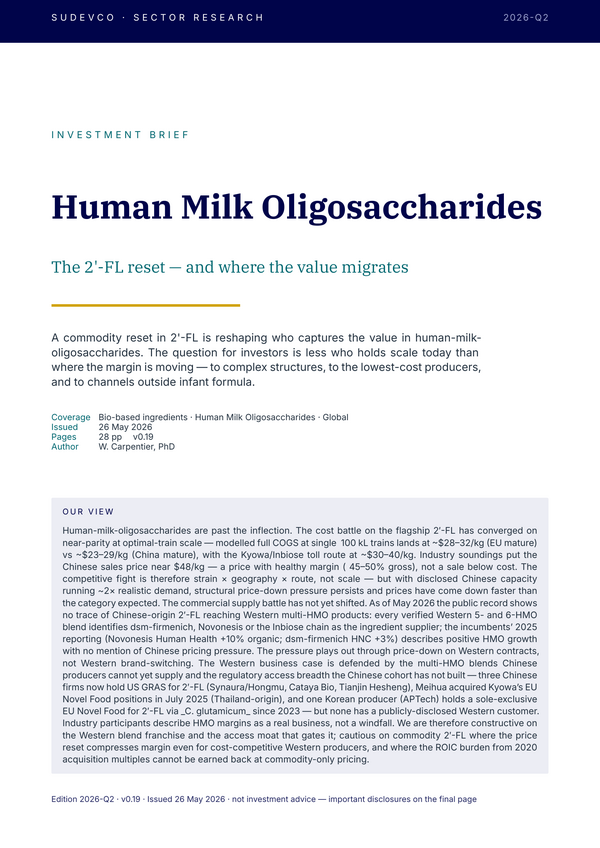
The HMO ingredient market sits at $0.35–0.4 billion today, on a path to ~$1.2–1.3 billion (combined TAM) by 2030. The investable story is what's happening inside it: a Chinese cost cohort that has closed to near-parity with Western mature plants at optimal-train scale, a Chinese commodity sales floor near $**·/kg that already carries healthy margin, a manufacturing-IP staircase running 2027→2035, and value migrating off the flagship 2'-FL into multi-HMO blends Chinese producers cannot yet supply to Western brands.
This brief makes the call in twenty-eight pages. The cost stack is built bottom-up at optimal-train scale; the IP cliff is read as a maintenance-fee schedule with named expiries; the regulatory access map is named structure × jurisdiction × player; the commercial supply battle is read against the public record (no Chinese-origin 2'-FL has surfaced in any verified Western multi-HMO product as of May 2026). The forward call is named, dated and falsifiable.
Authored by an operator with twenty years across the bio-based economy — global business-development leadership at DuPont Industrial Biosciences, CCO and CEO roles at specialty biotechs (including HMO), with transformation and exit; PhD and London Business School sustainability certification.
For investors and operators who need a defensible read on the category.
Decisive specific numbers — the Chinese commodity sales floor, the modelled COGS at single-train scale, the disclosed Chinese capacity, the post-2030 IP-cliff dates, the bear / base / bull TAM split — are blanked in this sample. They sit in the purchased brief.
Executive summary
Human Milk Oligosaccharides have crossed an inflection point. The category that took twenty years to clear the foundational CNRS patents, develop microbial production, and earn EU Novel Food and US GRAS approvals is now consolidating, commoditising at the 2'-FL tier, and bifurcating at the structurally complex end.
On the commodity side, Chinese capacity at three major producers has driven 2'-FL ingredient pricing toward $**·/kg — an aggressive entry price that, on our bottom-up COGS build, barely covers variable costs at the low end of the cost range and does not cover full COGS plus margin at any realistic scale. The sustainable commodity floor sits materially higher. The current price is a land-grab, not a stable cost-plus equilibrium. (Decisive numbers are blanked in this sample.)
On the complex side, structurally defined sialylated HMOs (3'-SL, 6'-SL) and longer-chain neutral structures (LNT, LNnT, complex blends) carry materially higher COGS, harder regulatory pathways, and the strongest clinical evidence. Margin durability lives here, not in 2'-FL. The Western incumbents (DSM-Firmenich post-Glycom, Novonesis post-Jennewein) have the IP, the regulatory file, and the customer relationships; the rising Chinese tier (Meihua-now-with-Kyowa-IP, Synaura/Mengniu) has the cost structure and is closing the regulatory gap.
The forward call — reserved for the full brief — names who wins, who loses, and what specific 2026 clinical and regulatory events would change the view.
Excerpt · Section 4 — The cost reset: strain, not scale
The Chinese 2'-FL reference price of approximately $**·/kg in early 2026 has been read in two opposite directions. One read treats it as the new commodity floor — the level at which microbial 2'-FL has reached cost-out maturity and will stay. The other read treats it as a land-grab price — below sustainable cost-plus-margin economics, designed to foreclose Western entrants from the application categories where 2'-FL is sufficient.
The COGS arithmetic decides between them. A bottom-up build for a Chinese-scale single-train 2'-FL plant gives a full-COGS range with named components — feedstock, energy, capex depreciation (anchored to the China-vs-Western fermentation capex gap reported by the China Fermentation Industry Association at roughly one-third of Western equipment cost), labour and overhead, and other OPEX. Layered on top is the Chinese export-VAT rebate on the relevant HS code, a further per-kg reduction at the reference price. The component cost ranges and the reference price are asterisk-blanked in this sample; they sit in the purchased brief.
— Excerpt continues for two more pages in the full brief, including the cost-waterfall exhibit, the EU vs China landed-cost comparison, and the DSM Glycom acquisition ROIC arithmetic callout.
Table of contents
- 0. Executive summary and investment view1.5 pp
- 1. The science on-ramp3 pp
- 2. The industry arc: how we got here1.5 pp
- 3. Market size: the birth-rate ceiling and what breaks it2.5 pp
- 4. The cost reset: strain, not scale3 pp
- 5. Intellectual property: catch-up, cliff, and cross-licensing3 pp
- 6. Regulatory optionality: the mandate and the pipeline2 pp
- 7. Competitive map by archetype2.5 pp
- 8. Where the exposure lives1.5 pp
- 9. Risk register1 pp
- 10. Signposts, forward view, and thesis-invalidation triggers1 pp
- App.. Methodology, COGS detail, clinical pipeline, IP query record3.5 pp
The full brief carries a named, dated and falsifiable forward call, with every modelling assumption stated and the decisive numbers in place.